
Fear and Other F Words in the Workplace
by Tatiana O'Toole • About 16 min read reading time
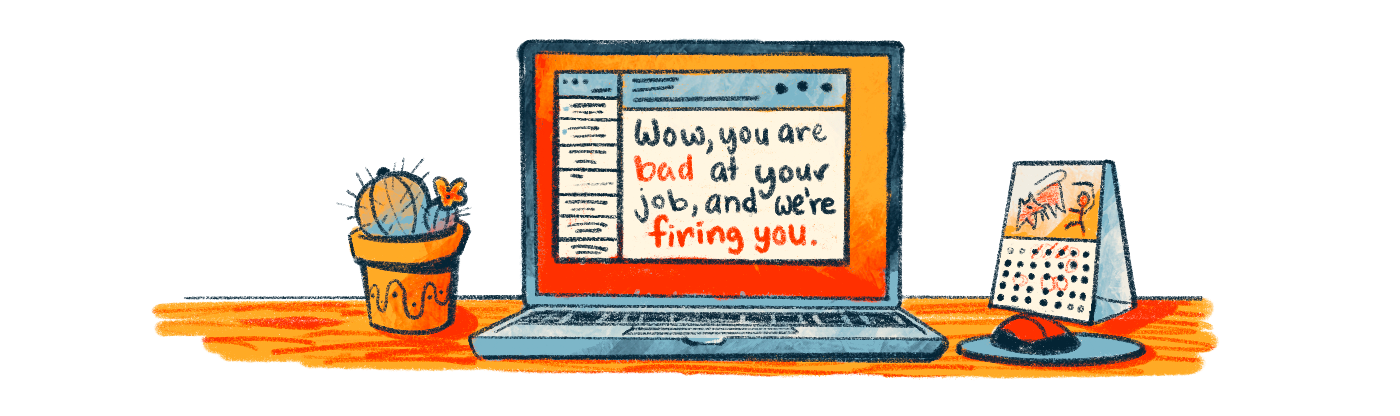
A single chime and an email comes into your inbox. It’s feedback from your manager. You have been waiting for it longer than usual, and deep down in your gut, you know it’s because it’s not good news. As your eyes scan the first sentence, your fears are confirmed. Anxiety gives away as sense of dread washes over you, and -for some reason- an overwhelming urge to browse your phone fills your mind. You are in a fear response.
If a potted plant comes flying towards your face, you jerk your arm up in an automatic response to protect yourself. This is a sudden reflex to a physical threat. Our bodies rely on instinct and learned behavior to define actions that can be deployed quickly and with minimal thought to keep us safe. You did not have to think about the reflex; your body is trained to protect itself.
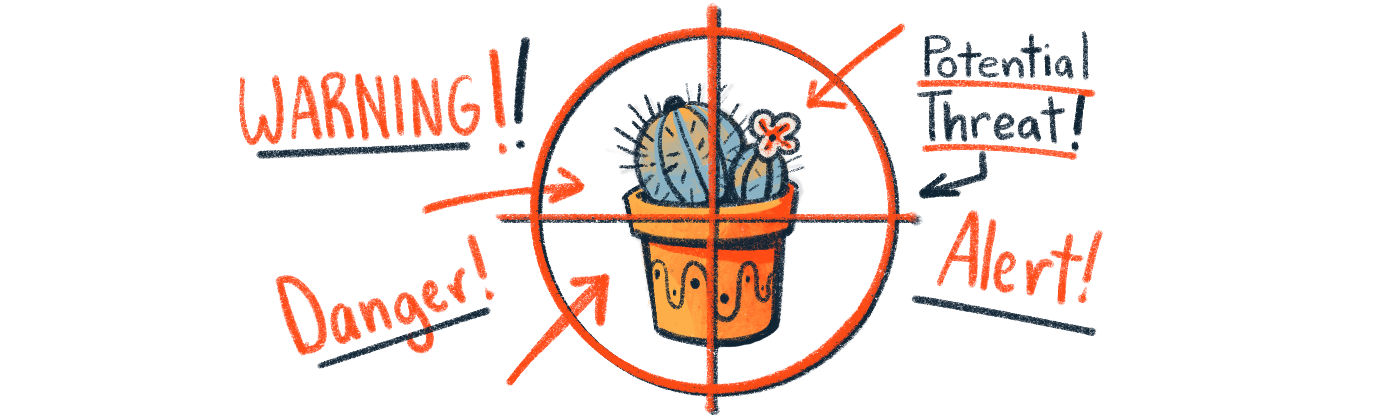
Lowering your arm, your eyes are wide, your heart is racing, and you draw shorter and faster breaths as you glance around for any more danger. All your senses are on alert. Another automatic response has started that is so natural that you may not even be aware of it. Your sympathetic nervous system has engaged what is commonly known as the fight or flight response.
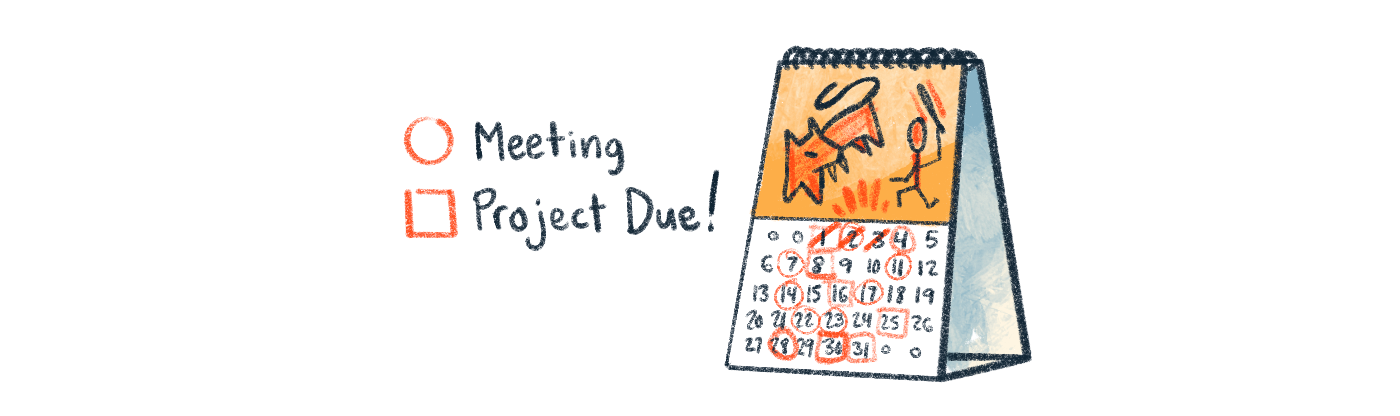
The fight or flight function is a very primal survival response, and we often use saber tooth tigers and cave men as examples of the behavior. But saber tooth tigers are extinct, and most of us live in a world where threats are less furry and bloodthirsty. Now we deal with much more complex fears that involve how we survive and navigate living in a society.
In this modern world, work is how we survive.
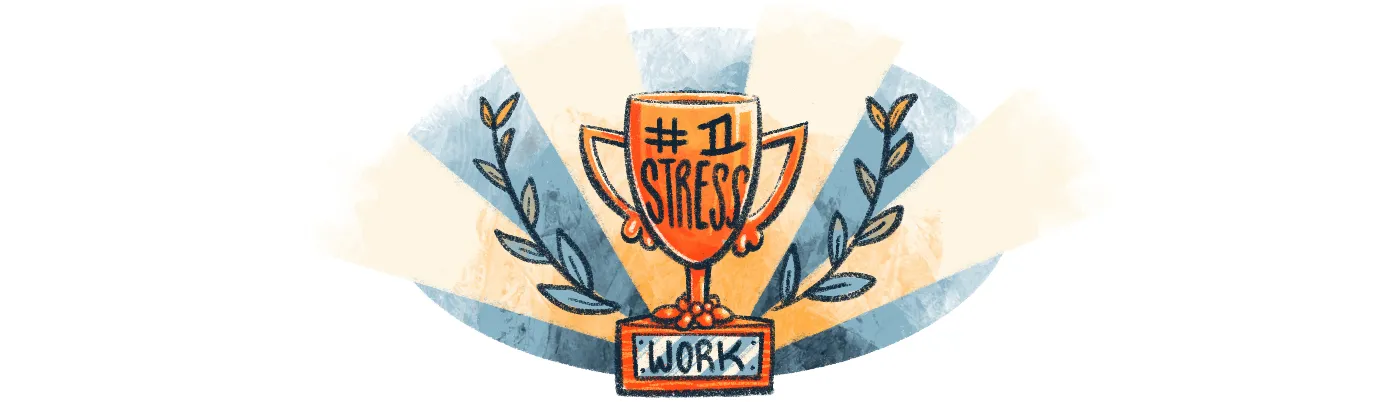
The CDC and National Institute on Occupational Safety & Health name the workplace as the number one cause of life stress. If our job (or the ability to do our job) faces any sort of risk, we feel threatened. Without income, we cannot afford the things we need to survive like food, water, and housing. If we lose our job, we experience shame and guilt as our savings are drained until the burden of our cost of living falls on others. And with lack of purpose and fulfillment that work provides, our self esteem and self worth drops. There’s a lot
riding on having a job that provides income.
Worrying over job security becomes a mental weight on us. We worry about earning enough to pay bills and being valued by our employers. We do things outside of our comfort zone and work with people we dislike. We sit through hours of meetings, speak the corporate speak, and fake our interest/understanding/passion for what we do. Work becomes a near constant slow drip of fear in our lives, and we call that slow drip “stress”.
This is not healthy state for humans or any living creature. And since workplaces are where people rely on each other in teams to reach a common goal, this creates a hotbed for conflict and problems. In this article, we are going to talk about those problems, the mechanics of our minds, and very human reactions to fear.
Your Body and Brain on Fear
First, let’s talk about the physical changes to our bodies when we sense a threat.
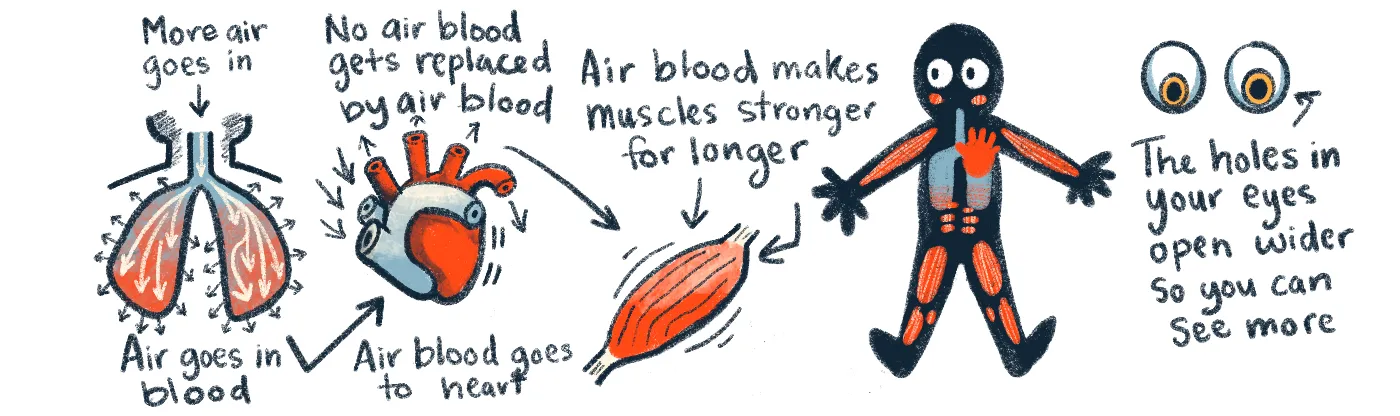
After a threat is sensed, adrenaline is sent throughout the body. This causes faster breathing and your heart rate to increase. More air is entering your body and your blood is moving it faster to the crucial locations. Your oxygen prepped muscles tense up, and your eyes dilate to see better. Your body is physically bracing for impact while preparing to react.
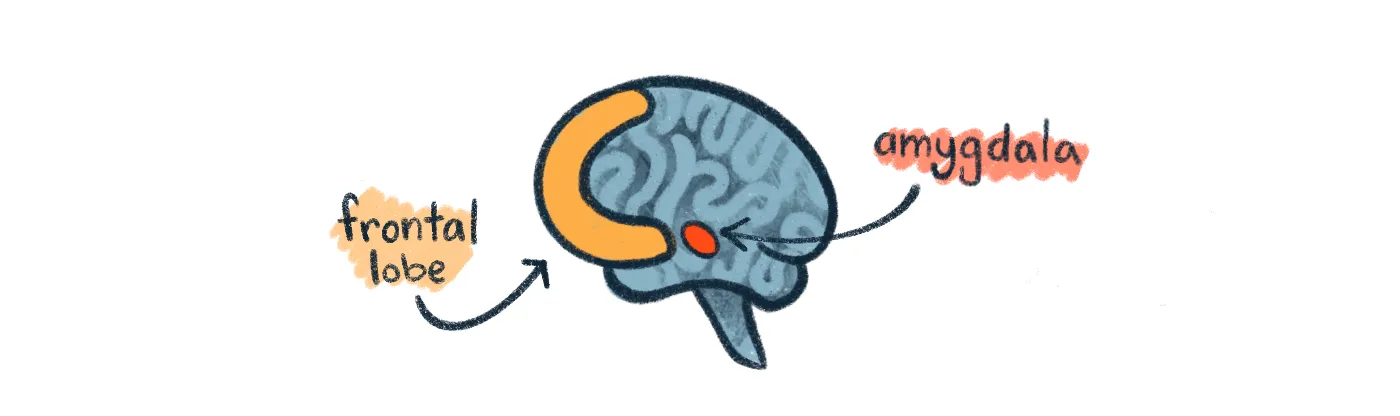
Meanwhile your brain is also adapting. Blood flow is decreased to the frontal lobe of the brain and instead increased to a different part of the brain, the amygdala (uh-mig-duh-lah). Just like with your muscles, what receives more oxygen will be more activated and responsive.
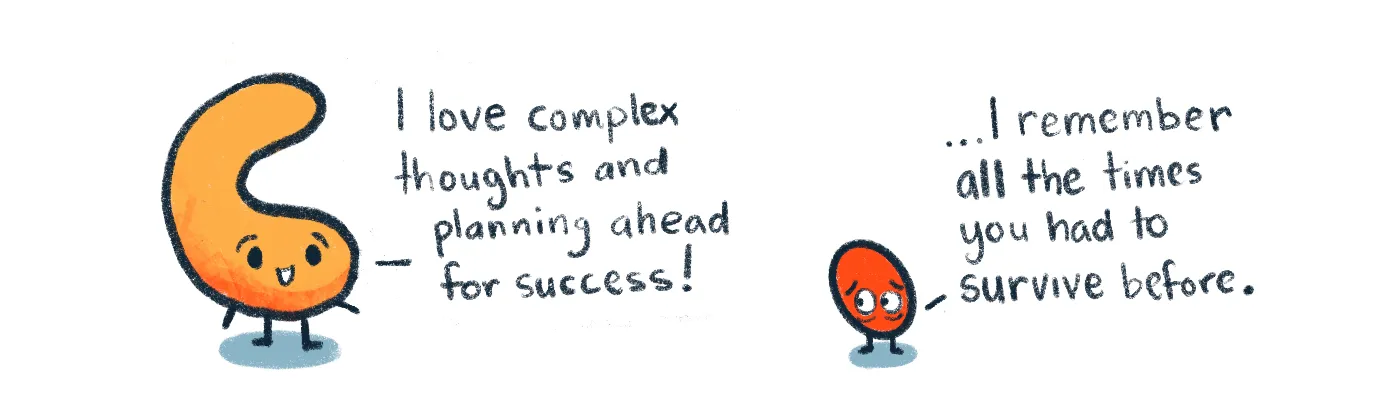
Different parts of the brain handle different things. The frontal lobe handles complex thought and planning ahead. The amygdala is a more primal part of the mind. It handles fear and emotional memory. Think of it as a library of instructions for how to react to protect yourself.

Starting from your earliest years, you log how to deal with scary situations in your amygdala via emotional memories. We make these memories growing up in our families, going to school, hanging out with friends, dating people, and inside work environments. From moments of mild anxiety to full blown panic, our amygdala refines the memories down to emergency instructions. You may not remember all the details, but your amygdala remembers what got you through it. It works subconsciously to guide your actions.
With its increased blood flow, the amygdala is going to try to take over as your guide. To your body, the future does not matter if the threat kills you. So the critical thinker (the frontal lobe) takes a backseat. Logic is out, survival is in. You’re now using a different part of your brain, the one that stores the memories of the tactics that got you this far.
TL;DR: When you are stressed or frightened, your body prepares itself to react while scanning for more threats, and a different part of your brain takes control of your decision making. This part of your brain is deeply emotional and highly irrational when compared to the day-to-day part of your brain.
The Four Major Fear Responses
A combination of the leading amygdala and the following frontal lobe will dictate actions based on these emotional memories and what you found to be successful in the past. Did you stay and fight? Did you run away? Did you just freeze? Or did you try to calm down or fix the situation?
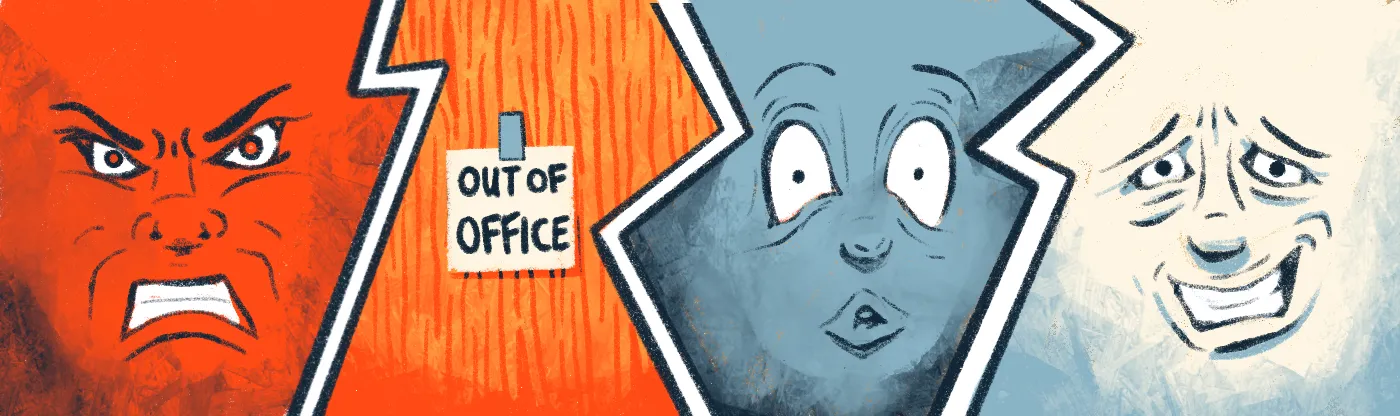
The four main fear responses are fight, flight, freeze, and fawn. They are not star signs or personality types; they are complex reactions based on the situation, people involved, past memories, desired outcome, and energy levels. So given the situation, each person can be a fight, flight, freeze, or fawn.
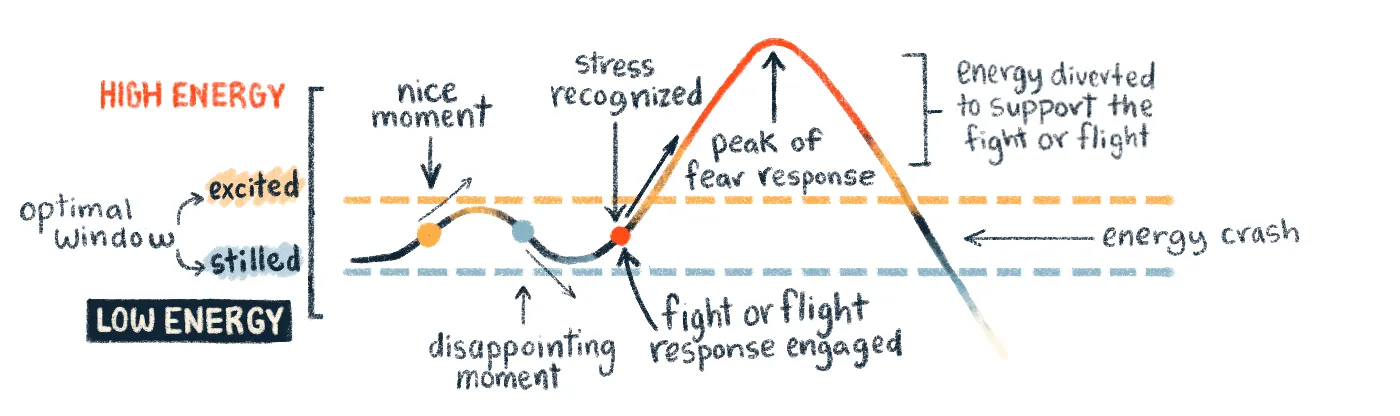
If you have the energy and confidence, you are more than likely to respond with fight or flight. These require a lot of energy whether you are confronting the fear or running from it. When choosing these responses (whether subconsciously or intentionally), you feel prepared and sure that will you successfully gain the upper hand.
However, if you do not, your body will begin to shut down and opt for the lower energy fear responses: freeze and fawn. When you are worn down or know you can’t win in the situation, you take desperate measures over active choices. Constant stress, untreated trauma, and physical/mental exhaustion increase the chances of responding with freeze or fawn.
What do Fear Responses Look Like in the Workplace?
Fight: Overpower the Threat
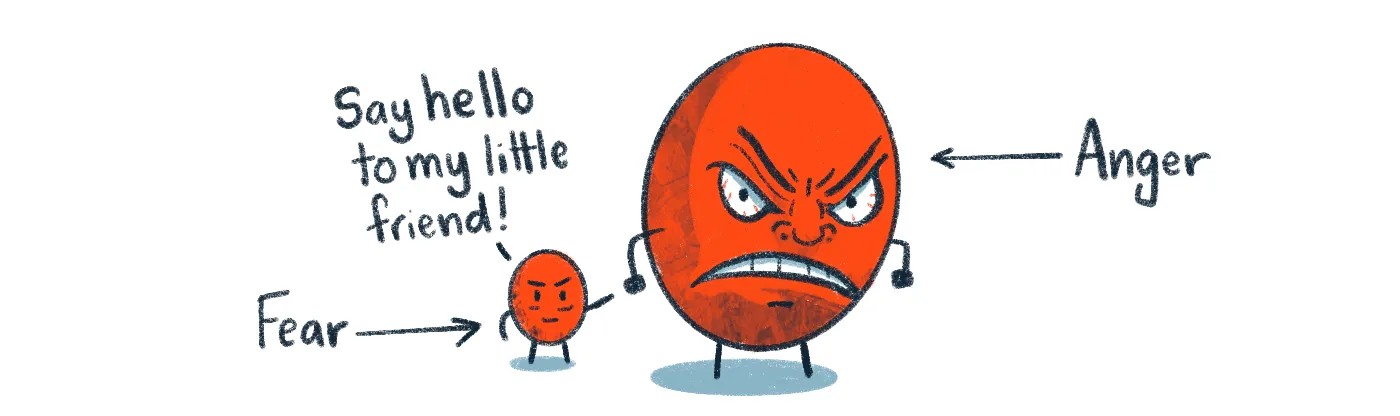
The fight response stands its ground and attacks, and a secondary emotion comes into play: anger. To protect our vulnerable selves, we become angry when we are scared, disappointed, frustrated, or humiliated. Anger exists to protect us.
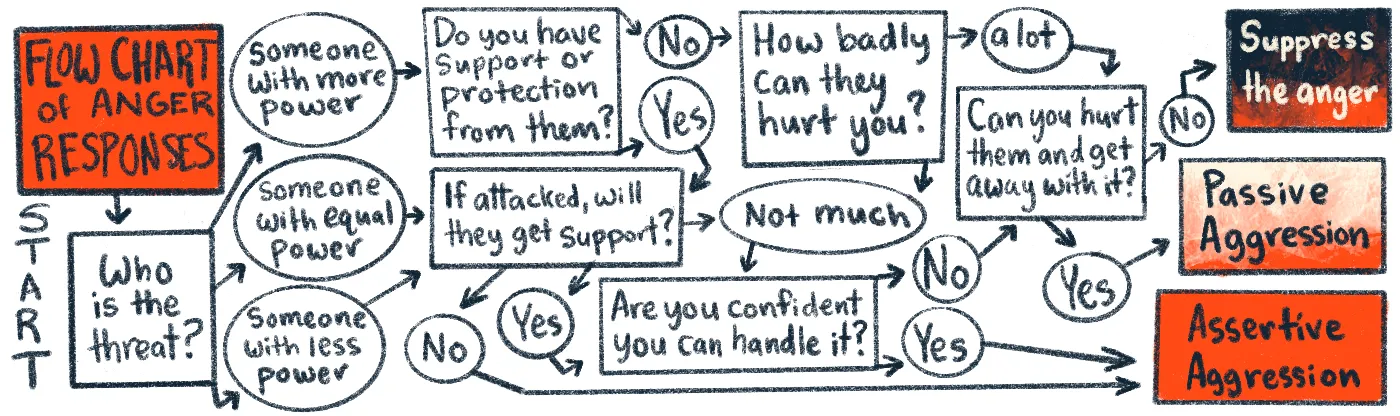
Anger reactions have risks because they often involve violence. Society is more accepting of verbal and mental violence when compared to physical, but too much of any violence is socially unacceptable. It can also trigger anger in other people who are acting in their own defense or in the defense of others. Because of the potential consequences, reactions driven by anger are largely influenced by social structure and power dynamics. People try to adapt their responses to what they believe they can get away with.
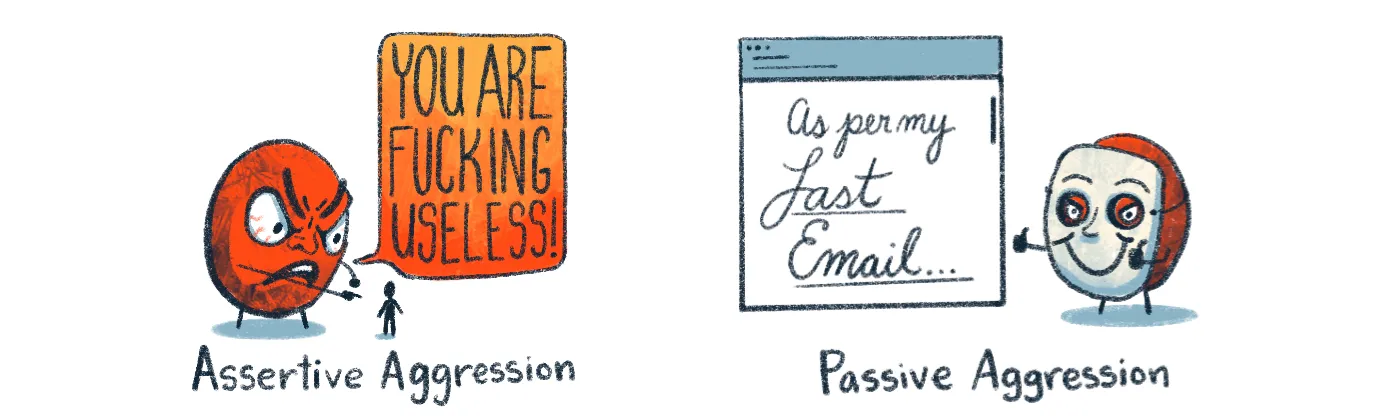
Anger is often expressed through aggression, and it has a wide range from passive to assertive. Subtle verbal jabs, gossiping, and quietly sabotaging people is passive behavior. Assertive aggression is shouting, name calling, and threatening others. Bosses or managers have more power in the workplace, so they tend to use assertive tactics. Employees and coworkers hold less or the same power as others, so they opt for the less noticeable, passive responses that won’t get them in trouble. An aggressive outburst of rage from a company owner may not even get them anger management training. An aggressive outburst from an unpaid intern may result in immediate dismissal and a reputation that follows them.
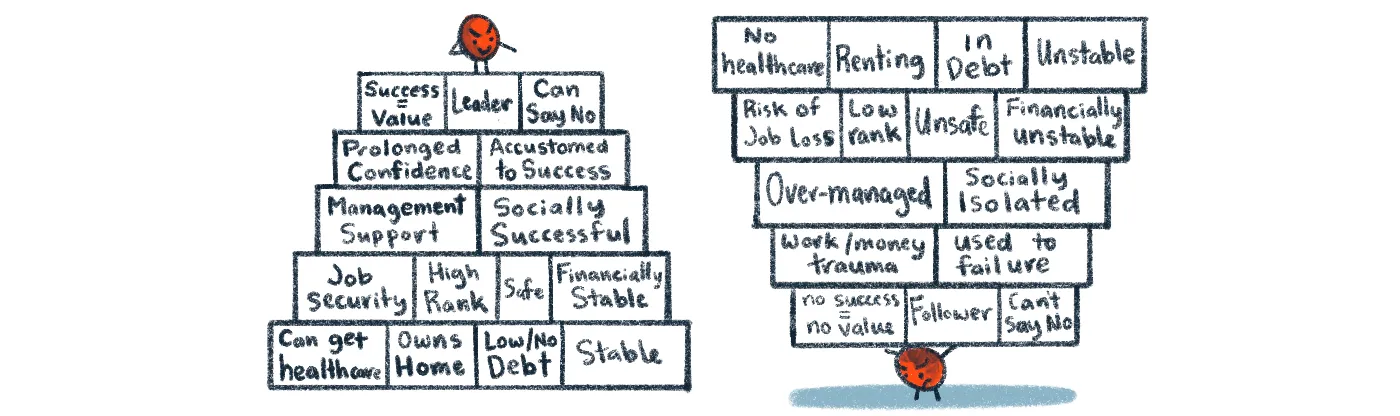
So with the fight response, people in positions of secure power tend to be more flagrant as they are confident their actions will only benefit them. Others without such an advantage “get even” by passive aggressively fighting back. Regardless of whether it is obvious or more
subtle anger, getting angry at someone or something generally does not fix the problem. Suppressing the anger is also an option, but those emotions will eventually come out- either in the workplace, at home, or out into the world.
Flight: Run Away from the Threat

If you can not win with the fight response, the next best option is to get away from the problem. In the flight response, high energy fuels avoiding the source of fear. People in a flight response make themselves unavailable and get out of projects and responsibilities. They often
fill their schedules with busy work so they do not have to face the thing causing them stress. Being absent for meetings, leaving work often for a myriad of reasons, and avoiding responsibilities for the lightest of excuses are examples of this. It’s a form of high energy
procrastination.
There are obvious consequences for abandoning responsibilities. If ignored, problems tend to get more urgent and difficult to deal with. Other people may be picking up the slack and feeling resentment towards the person not doing their job. But alongside these issues, avoiding responsibilities causes shame, guilt, and further anxiety inside a person. These are very uncomfortable emotions to sit with, and to deal with them, people engage in coping mechanisms.
Coping mechanisms are used by people to distance themselves emotionally from stress. They can be directed towards others or towards themselves. In this article, we are going to focus on negative coping mechanisms, but it’s important to remember that not all coping mechanisms are harmful to people, the individual, or the issue. Going for a walk in nature, meditation, spending time with someone you enjoy, and reading a book are examples of beneficial coping mechanisms. Harmful coping mechanisms involve excessive consumption, self destructive behavior, and passing pain on to other people.
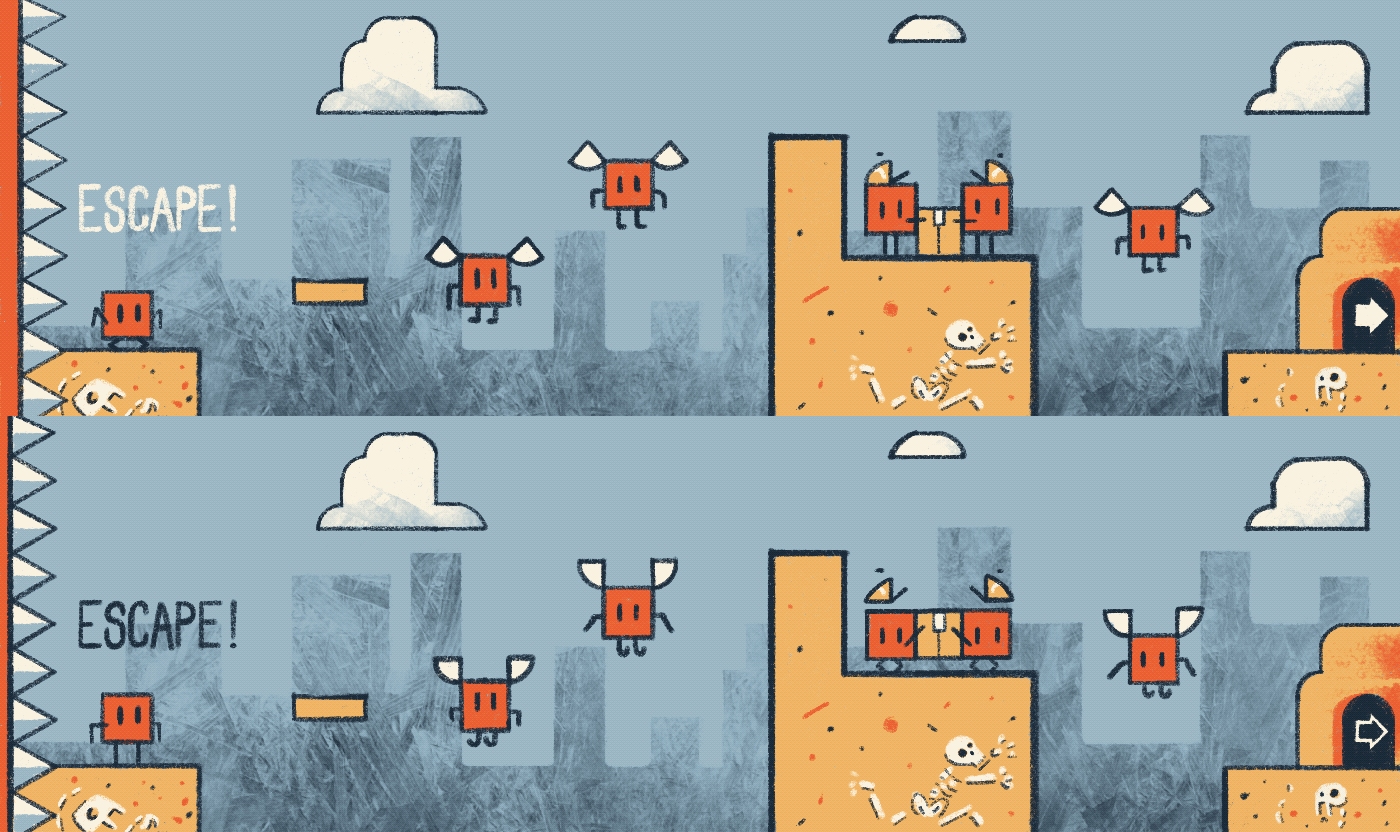
When flights pass on the blame and stress on, it is a coping mechanism directed towards others. They dump their anxiety on other situations and people, inside and outside of the workplace. Focusing on irrelevant details, getting irrationally upset over small things, and micromanaging others helps distract them from what’s really bothering them. Flights can also finger point and place blame on other people and things as to why they haven’t gotten their own work done. Other people with unfinished work are an easy scapegoat when in reality, people in flight often are looking for any excuse to be blocked.
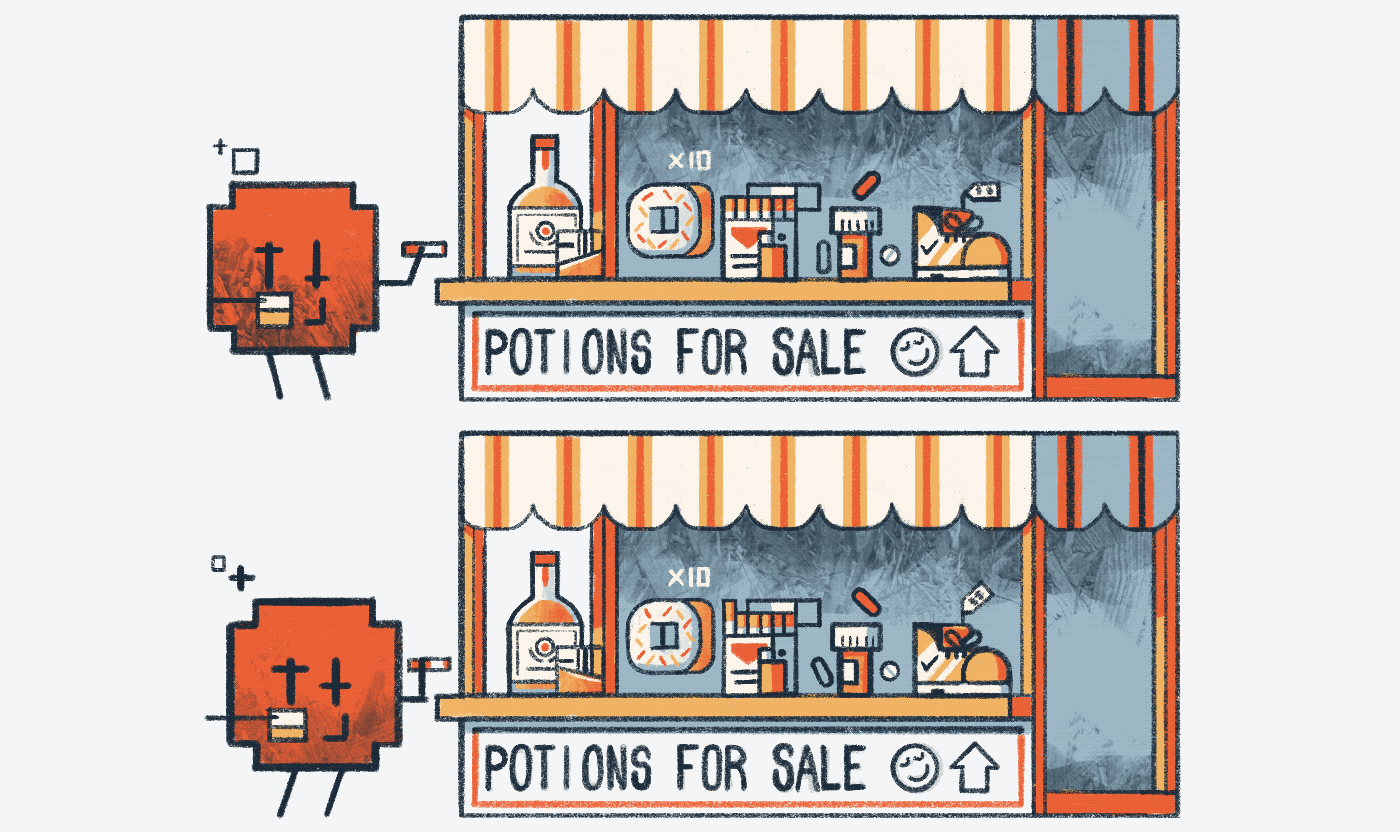
Negative coping mechanisms aimed towards themselves are often forms of self
destruction, often through over consumption. These are things like nail biting, retail therapy, excessive drinking, smoking, drug use, and over eating. These numb those uncomfortable emotions mentioned before. Extensive use of self destructive behaviors can have negative
consequences on the individual. They increase wear and tear on the body, suppress healthy emotions, financially strain the individual, and can fog their rational thinking in the short and long term.
While flights simply make themselves disappear, other people are left to pick up the pieces. When fight response individuals are able to engage flights, the flights can run over other people to get away or shift into a different fear response to deal with being unable to escape.
Freeze: Be Overwhelmed by the Threat
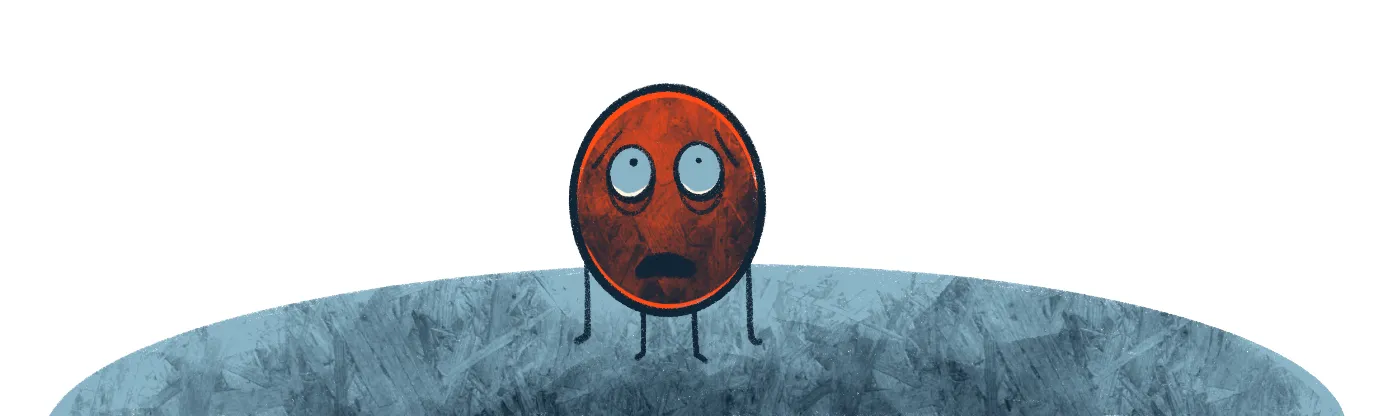
The freeze is one of the two responses made in hypo arousal, when energy is short supply. In the freeze response, the individual has no energy or confidence that would allow them to fight or flee the situation, and now they are just stuck. Freeze is less of a choice and more of a
blinking “service engine” light. Compared to flight’s high energy procrastination, this is the low energy form.
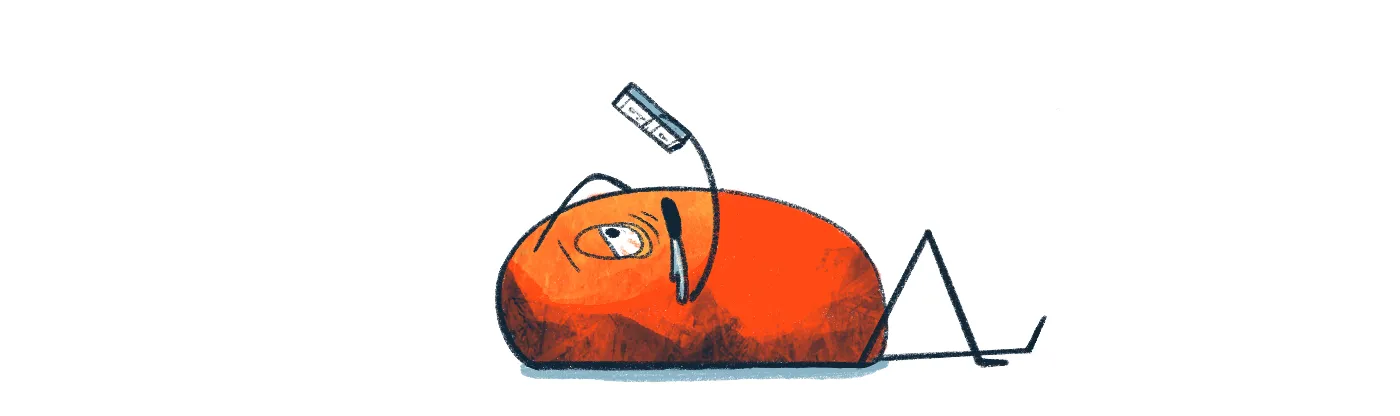
Freeze shows up as procrastination or creative block. It is endlessly scrolling social media feeds, flitting between tasks without making any forward movement, or staring blankly into space. They are stuck on idle- whether consciously or subconsciously. Any time they attempt to approach the issue, they are lost in a void of no motivation and no creativity.
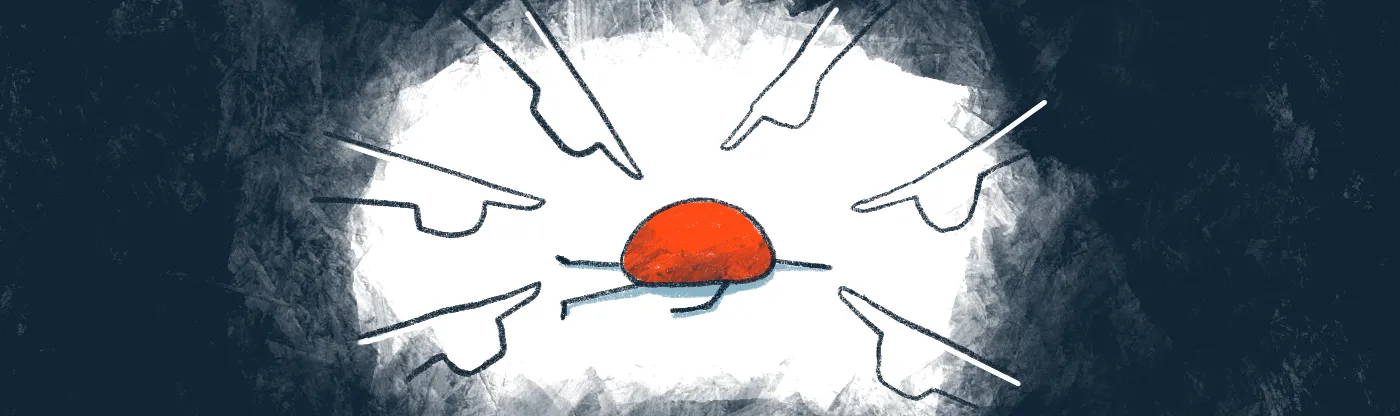
But because they do nothing, frozen people often get blamed by people in flight who are able to leave the problem. They are picked on by fights who are either too upset to recognize the struggle behind the freeze response or do not believe that it exists. In their minds, people not doing their jobs are lazy, have no work ethic, and are just terrible at their jobs.

With all that said, it is often that people frozen in place are the hardest on themselves. They want to fight for themselves, but do not have the confidence or energy. They want to step away, but they feel compelled to try to work instead from obligation, fear, or guilt. They mentally punish themselves for not being able to concentrate or perform. They want to work, but their minds and bodies are not responding. They then interpret this as being bad at their job and not good enough. This, of course, does nothing to improve their situation and only makes it worse.
Fawn: Soothe the Threat
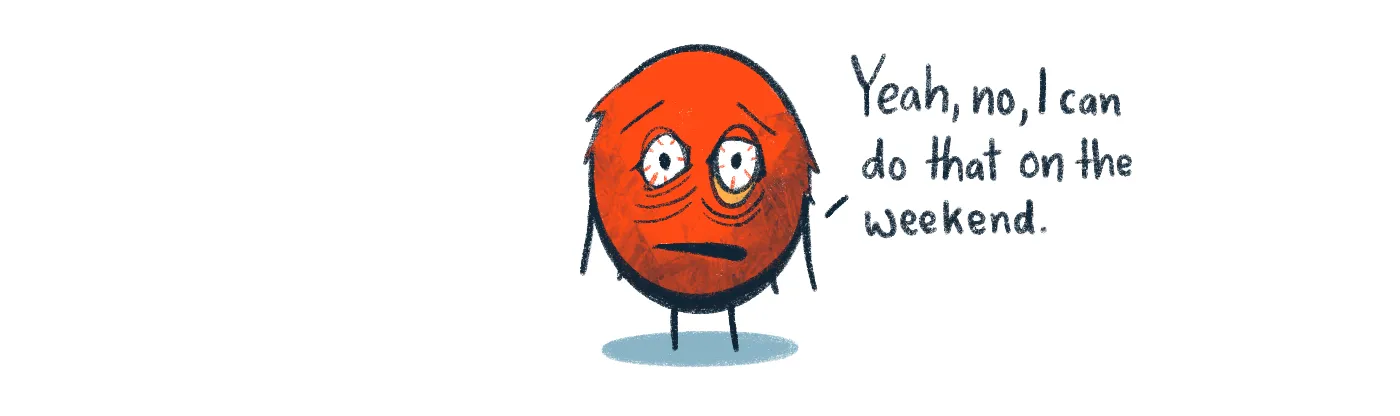
When energy is low and the threat is demanding a response, surrendering is one of the last options. A person who fawns in work gives beyond what they are physically or mentally able. They can not win the fight, they can not successfully flee, and staying frozen is impossible as the threat demands their interaction.
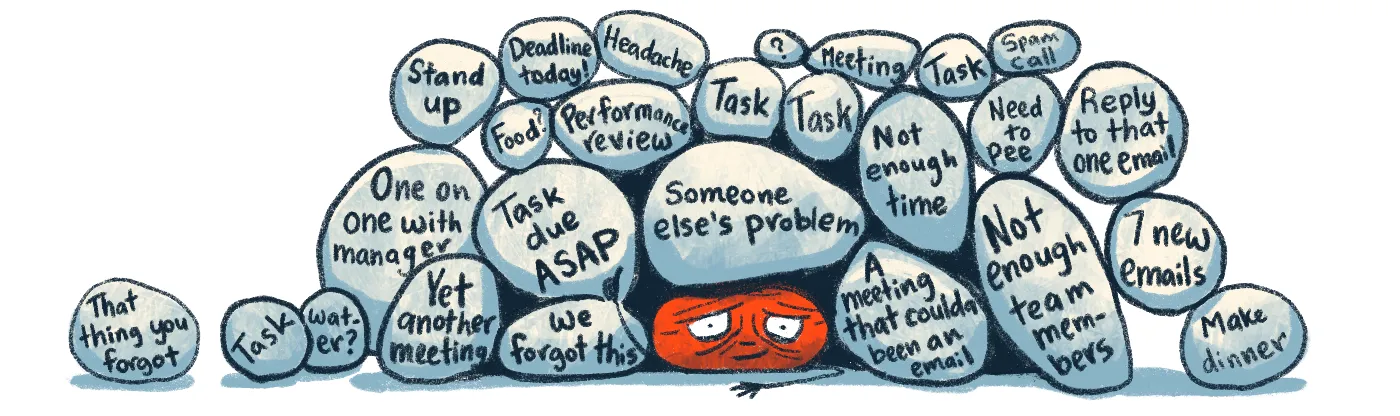
People fawning believe that taking on the work of others will fix the situation and keep them safe. If there is a failure somewhere in the process, they take it upon themselves to make up for it. The fear of saying no becomes greater than the threat, and they become swamped with work.
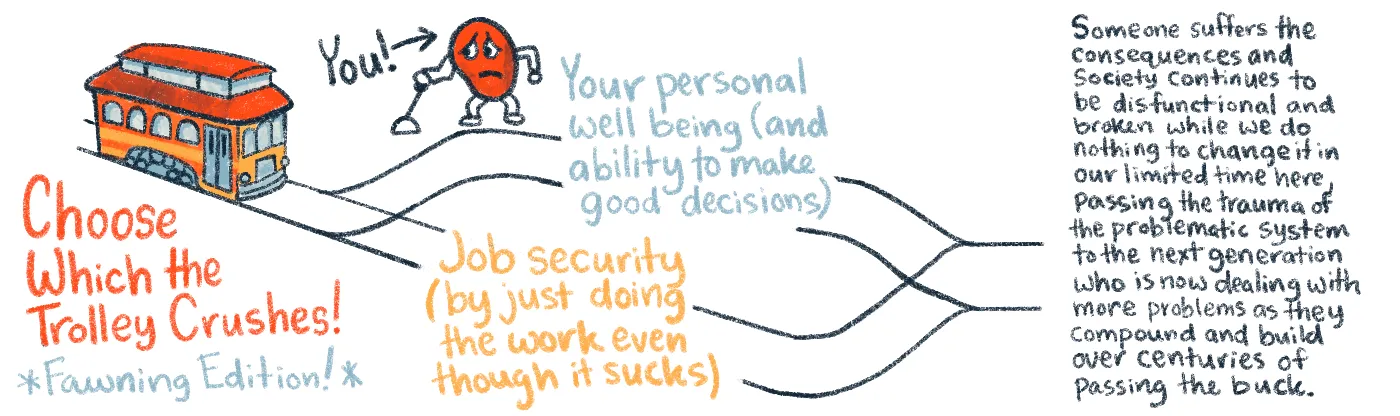
Some consider this a net good because they are working, especially people in other fear responses whose workload is lightened. However, when people work harder than their mental and physical health can handle, this causes problems. More mistakes are made by overworked employees. Work turn around takes longer. While in a survival mindset, right and wrong become blurred as the most important factor in judgement is just getting the work done. This can lead to unethical and harmful business decisions and practices. And while all this happens, emotions that fuel bad behaviors begin to rise.
Fawns can begin to develop resentment towards others and a sense of entitlement. “If I can do it, why can’t they?” This can turn those fawning back into the fight response when pushed far enough and their energy returns. They then use their self sacrificing behavior to guilt others into working beyond their means. Management and leadership positions in the fawn response can drive their teams into the ground as they set an unsustainable path to burn out through overwork.
By not voicing their needs and boundaries, they endanger their health and well being. They pour from a cup that is constantly empty, and they set a poor standard for workplaces by working beyond their means. Fawns work hard to appease the fights and pick up the slack from flights and freezes. Fights often treat them poorly as scapegoats because they know
they can get what they want from them. Flights are happy to have someone else face their responsibilities, and freezes sit quietly.
Bonus F Words
The following are also fear response variations, but not considered to be within the main four.
Fine
(denying the problem by saying “everything’s fine!”)
Friend
(befriending and cozying up to the threat in the workplace)
Feign
(engage in intense self blame or deprecating behavior before the threat can act, therefore encouraging the threat to comfort them rather than criticize them)
Fright
(threatening without following through with action)
Flop
(essentially playing dead)
Faint
(actual physical collapse)
The Wrap Up
Outlined above is a more proactive and beneficial way of looking at ourselves and others in the most frustrating circumstances. Instead of seeing a coworker as lazy, they’re now depleted of energy and defeated. Instead of being scared of a enraged boss, understand that it is them who is scared and very poorly managing their emotions (and maybe this isn’t a safe working environment for you).
It’s not easy to always look at the workplace through this lens, especially in stressful situations. However, two things are critically important when working with others:
- When interacting and working together, we owe each other respect, kindness, empathy, and understanding.
- Having a more accurate understanding of a situation sets the stage for more
sustainable and effective problem solving and solutions.
This is the first part of a multi part series discussing the fear responses, how they impact the work place and individuals, how our minds and bodies work, and ways for all members of a company to take action in making work places more safe, functional, healthy, and productive. In the next part, we’ll be talking about the mechanics of the mind and why people react the way they do to fear.
Thank you for reading. Everything I write is written with the intention of moving people towards a healthier, more united, and more joyous world. If you want to support me and my writing, you can buy me a coffee. No AI was used in the writing or illustrations in this article.
This article with written with the help of Dr. Boon Wan Wang-Whelan, a neuroscientist, a psychotherapist specializing in play therapy, and a dear friend. You can find more details about her and her work at wayfindingwithwen.com. Thank you, Wen.
organizations stress fear psychology brain fight flight fawn freeze laziness anger toxic workplace